
TFF
Policy Hackathon
& Youth Forum 2026

TFF Policy Hackathon 2026 Prompts
The 2026 TFF Policy Hackathon focuses on three urgent, concrete, and real-world issues. Each addresses a genuine policy dilemma currently unfolding—not a hypothetical scenario or a simulation, but a governance challenge demanding attention right now. At the same time, we remain steadfast in our belief in the power of dialogue.
The TFF Youth Forum returns, continuing to provide a platform for thinkers and practitioners to connect across borders. We invite you—regardless of whether you consider yourself a "policy expert"—to pick up your pen and join this constructive conversation about the future. Every word written is a vote for a better world.
Track A:
AI & Public Governance
Designing Trustworthy Governance in the Age of Artificial Intelligence
Artificial intelligence is rapidly transforming public services, education, healthcare, and the workplace. Governments around the world are exploring how to harness AI to improve efficiency and innovation while addressing concerns about transparency, accountability, bias, privacy, cybersecurity, and public trust.
Challenge
Design a policy proposal or analysis report that enables governments to responsibly integrate artificial intelligence into society while protecting the public interest. Your proposal should balance innovation with ethical governance and consider the perspectives of multiple stakeholders, including citizens, policymakers, researchers, and industry.
Participants are encouraged to address issues such as:
-
AI regulation and accountability
-
Transparency and algorithmic governance
-
AI in education or healthcare
-
Data governance and privacy
-
Digital inclusion and equity
-
Public trust in emerging technologies
*Note: Submissions should address one specific policy problem in a particular country, region, or local context.
Track C:
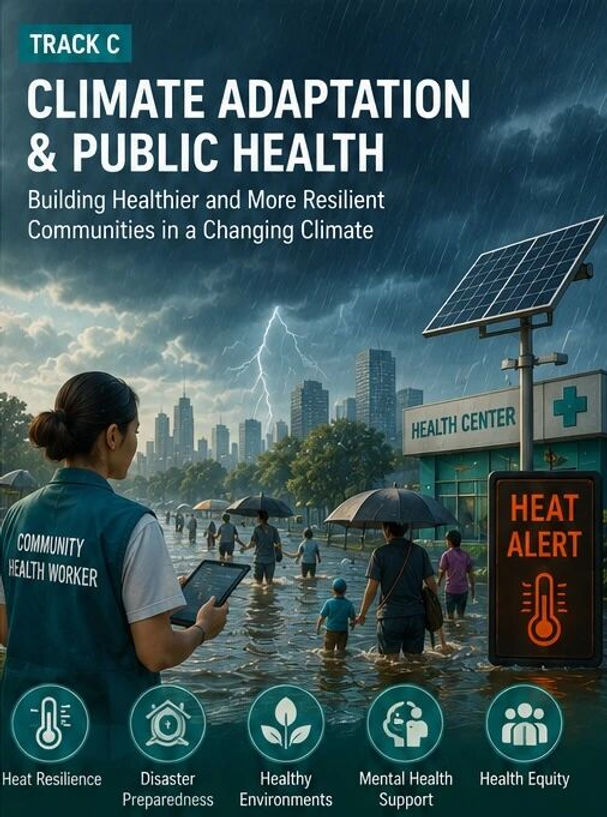
Climate Adaptation & Public Health

Track B:
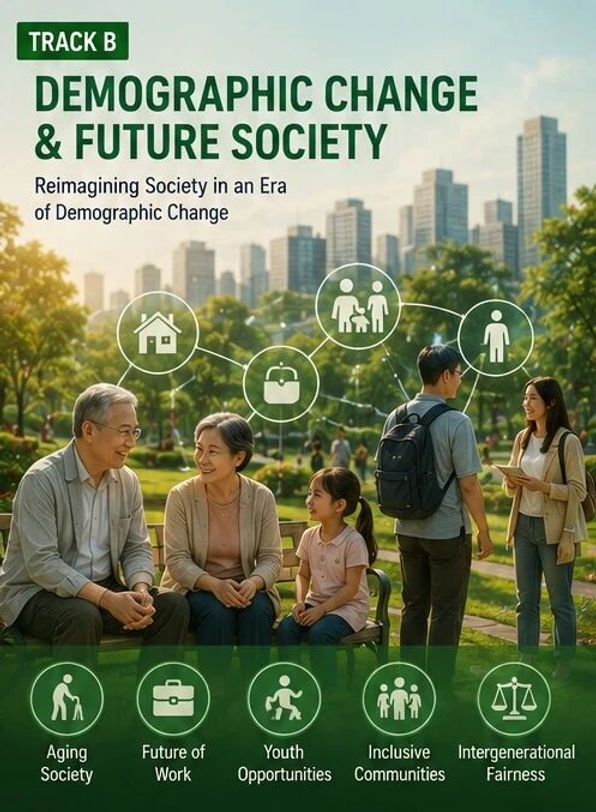
Demographic Change & the Future of Society
Reimagining Society in an Era of Demographic Change
Many countries are experiencing profound demographic shifts, including aging populations, declining birth rates, migration, urbanization, and changing family structures. These trends are reshaping labor markets, healthcare systems, education, housing, and public finances, presenting governments with complex long-term policy challenges.
Challenge
Develop an innovative policy proposal or analysis report that helps societies adapt to demographic change while promoting economic resilience, social inclusion, and intergenerational equity. Your proposal should consider both immediate needs and long-term sustainability.
Participants may explore topics such as:
-
Population aging
-
Low fertility and family policy
-
Migration and social integration
-
Future of work
-
Youth opportunities
-
Housing and urban planning
-
Intergenerational fairness
-
Community resilience
*Note: Submissions should address one specific policy problem in a particular country, region, or local context.
Building Healthier and More Resilient Communities in a Changing Climate
Climate change is increasingly affecting human health through extreme heat, air pollution, infectious diseases, food and water insecurity, natural disasters, and mental health challenges. While reducing emissions remains essential, governments must also strengthen their capacity to protect communities from the impacts already being felt.
Challenge
Design a policy proposal or analysis report that improves public health resilience in the face of climate change. Your proposal should identify a significant climate-related health challenge and recommend innovative, equitable, and practical policy solutions that strengthen community preparedness and well-being.
Participants may consider topics such as:
-
Extreme heat preparedness
-
Climate-resilient healthcare systems
-
Disaster preparedness and response
-
Food and water security
-
Mental health and climate anxiety
-
Urban resilience
-
Health equity
-
Community-based adaptation
*Note: Submissions should address one specific policy problem in a particular country, region, or local context.
Hypothetical Cases for Inspiration
Th examples below are intended to illustrate the distinction between the two submission formats. Participants are not required to address the hypothetical case and may choose any policy issue that falls within the scope of their selected track. Submissions must focus on a real-world policy problem in a specific country, region, state/province, city, or local community. Fictional settings are not permitted.
In general:
-
A Policy Proposal focuses on designing and justifying a specific policy solution to address a public policy challenge.
-
A Policy Analysis Report focuses on analyzing a policy issue or evaluating existing policies, using evidence to assess causes, impacts, trade-offs, and implications for future policymaking.
Track A
AI & Public Governance
The Ministry of Education in Country A has introduced an AI-powered system to help public schools identify students who may be at risk of dropping out. While the system has improved early intervention efforts, teachers and parents have raised concerns that the algorithm disproportionately flags students from low-income communities. Policymakers must now determine how AI can continue to support education while ensuring fairness, transparency, and public trust.
Example Submission Approaches
-
Policy Proposal: Develop a governance framework or policy package to ensure the responsible use of AI in education, such as transparency requirements, independent audits, stakeholder oversight, or data governance measures.
-
Policy Analysis Report: Evaluate the strengths and limitations of AI-based student risk assessment systems, analyze their impacts on different stakeholders, and assess the effectiveness of existing regulatory or governance approaches.
Track B
Demographic Change & the Future of Society
Country B has experienced a declining birth rate for more than two decades. At the same time, its population is aging rapidly, creating labor shortages and increasing pressure on pension and healthcare systems. Rural communities continue to lose young residents, while major cities face rising housing costs that discourage family formation. The government is considering a range of policy options but must balance long-term sustainability, fiscal constraints, and intergenerational equity.
Example Submission Approaches
-
Policy Proposal: Design an integrated policy strategy that addresses one or more demographic challenges, such as family support, housing affordability, workforce participation, migration, or healthy aging.
-
Policy Analysis Report: Analyze the causes and consequences of demographic change, evaluate current policy responses, compare international approaches, and identify key lessons for future policymaking.
Track C
Climate Adaptation & Public Health
A coastal city in Country C has experienced increasingly frequent heat waves and severe flooding over the past decade. Hospitals report growing numbers of heat-related illnesses, while flooding has repeatedly disrupted access to healthcare facilities in vulnerable neighborhoods. Local officials must develop policies that strengthen public health resilience, protect at-risk populations, and prepare the city for future climate-related health challenges.
Example Submission Approaches
-
Policy Proposal: Develop a policy package that improves climate resilience and protects public health through measures such as heat action plans, resilient healthcare infrastructure, early warning systems, or community preparedness programs.
-
Policy Analysis Report: Examine how climate change is affecting public health in the region, assess the effectiveness of existing adaptation strategies, and identify policy gaps and future priorities.
Submission Requirements
Participants may submit one of the following:
-
Policy Proposal
-
Policy Analysis Report
Submission Format
-
Language: English
-
Word Count: 1,000–2,000 words (excluding references and appendices)
-
File Format: PDF (.pdf)
-
Citation Style: APA 7th Edition
-
Originality: All submissions must be the participant’s original work. Appropriate citation is required for all external sources.
Submission Deadline
September 10, 2026 (11:59 PM EST)
*Deadline extended to October 5, 2026 (11:59 PM EST)*
Evaluation Rubric
Submissions will be evaluated by a panel of judges with expertise in public policy, research, and related disciplines.
Criterion | Description | Points |
|---|---|---|
Problem Definition & Policy Context | Clearly defines the policy issue, demonstrates understanding of its significance, and situates it within an appropriate social, political, economic, environmental, or technological context. | 20 |
Analysis & Use of Evidence | Demonstrates thoughtful analysis supported by credible evidence, research, data, and relevant case studies. Considers multiple perspectives and stakeholders where appropriate. | 25 |
Policy Thinking | Policy Proposal: Presents a coherent, innovative, and feasible policy solution with clear implementation strategies. Policy Analysis Report: Critically evaluates existing policies, identifies trade-offs and implications, and provides well-supported insights or recommendations. | 25 |
Feasibility & Impact | Assesses the practicality, potential effectiveness, limitations, and possible unintended consequences of the proposed policy or analysis. Demonstrates awareness of implementation challenges and long-term impact. | 15 |
Organization & Communication | Presents ideas in a clear, logical, and professional manner. Writing is well-structured, concise, and appropriately referenced. | 15 |
Total: 100 points
What We Value
The strongest submissions will:
-
Address a significant and timely public policy challenge;
-
Demonstrate critical thinking and analytical depth;
-
Incorporate credible evidence and diverse perspectives;
-
Consider trade-offs, feasibility, and real-world implications;
-
Communicate ideas clearly and persuasively to a policy audience.
Creativity is encouraged, but successful entries should balance originality with practicality and evidence-based reasoning.

Awards!
This year, TFF will award $650 in total prizes across three Tracks. Each track will recognize one Track Distinguished Award with a $150 award. Among them, one will be selected as the Global Champion, receiving an additional $50.
We honor clarity, originality, and courage in confronting complex issues—not just answers, but better questions.
Also,
Stay in Touch.
Follow us on WeChat/Weixin Public Account:
The Forbidden Flourish


